


Lucky Classic Tripeaks Game
4.6394.00 Reviews
App Specs
- Version
- 0.2.3
- Updated On
- License
- Free
- Downloads
- 100,000+
- Developer
- JOYWIN GAME
- Categories
- Card
- Platform
- Android
Screenshots

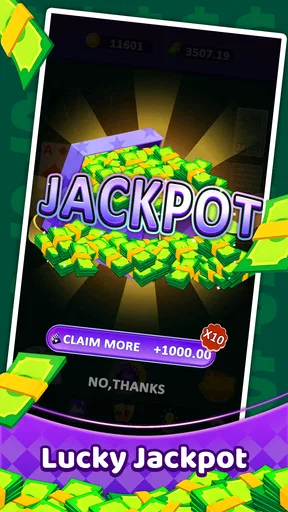
 Analysis by AppCompare
I went into Lucky Classic Tripeaks expecting a familiar solitaire card game with a luck-based presentation, and that is exactly where its appeal begins. It is a free card game from JOYWIN GAME, built around the Tripeaks format rather than a large collection of unrelated modes. The basic idea is easy to understand: clear cards from the layout by choosing cards that follow the current card in sequence, while trying to keep a run alive long enough to remove the peaks.
That simplicity makes it immediately approachable, but the presentation gives the experience a more focused identity than a plain solitaire clone. The game positions itself around classic cards and real-money rewards, so it is not trying to feel like a quiet offline puzzle in the traditional sense. The mature rating matters here: anyone installing it should treat the reward language as part of the product’s identity, not as a small decorative detail.
My first few rounds were easy to follow because the card layout does most of the explaining. I did not need a long tutorial to understand what I should tap next. The useful question is not whether the rules are complicated; they are not. The real question is whether you enjoy making small probability-based decisions under a brisk card-game rhythm. If you do, this can be a pleasant short-session game. If you want deep deck construction, a story campaign, or a completely relaxed solitaire app without reward-oriented framing, it is probably aimed at someone else.
How the card table creates its own mood
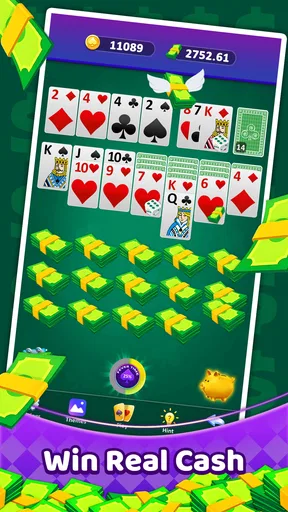
The visual language is built around the recognizable Tripeaks table. That choice is important because the game does not need a fantasy world, character cast, or elaborate narrative to communicate what it wants you to do. The cards, the exposed paths, and the remaining peaks form the setting. I found that directness useful: the screen stays centered on the puzzle instead of asking me to learn a separate fictional universe.
There is a particular kind of visual tension in a Tripeaks layout. At the start, much of the board is hidden behind face-down cards, so every successful move feels like a small reveal. The three peaks give the table a clear shape, and that shape helps me read the board quickly. I can see where a run might open a path and where a tempting move could leave me with fewer useful options later.
This is where the art direction and mechanics work together. A card game can look attractive and still make the playable information difficult to read. Here, the classic format is valuable because the symbols are familiar and the objective remains visible. I do not have to decode a complex interface before making a decision. The strongest visual moments are not dramatic effects; they are the moments when a blocked section opens and the remaining layout suddenly looks manageable.
That also reveals a limitation. A classic card table has less room for visual variety than a narrative game or a heavily themed strategy title. After several rounds, the pleasure comes mainly from the changing card arrangements and the decisions they create, not from discovering new scenery. Players who need constant visual novelty may find the presentation restrained.
Worth Reading Before You Choose

EA SPORTS FC Mobile 26 Is a Bigger Football Game, but It Takes Time

Flipboard Shows What News Apps Must Do Beyond the Feed

Switching to Android Auto Means Rethinking Your Driving Routine

Google Calendar Makes a Crowded Week Easier to Manage

Ludo King Makes the Most of the Minutes Between Plans

Baby Panda World Brings Quick Play to Modern Phones, but Its Game Library Feels Busy
I also think the mature audience positioning changes how the setting feels. This is not presented as a children’s card activity or a purely educational solitaire exercise. The reward-focused framing gives ordinary card clearing a more transactional atmosphere. Some players will find that motivating, while others may prefer an app where the satisfaction comes only from solving layouts and improving personal consistency.
The opening minutes tell you what kind of game this is
The first impression is strongest when I treat each round as a compact decision session rather than as a long-form game. I can look at the exposed cards, identify a possible chain, and begin playing without a large commitment. That makes it suitable for a short break, especially when I want something more active than scrolling but less demanding than a full strategy match.
A useful early habit is to pause before tapping the first obvious move. In Tripeaks, the card that can be removed immediately is not always the card that creates the best route through the layout. I try to scan for cards that may extend a sequence in either direction and pay attention to which face-down groups could be uncovered by clearing a particular branch. This small pause adds more thought to the game without making it feel slow.
The game’s current version is 0.2.3, which places it in an early stage of development. I would keep that in mind when judging the experience. The core card loop is understandable, but an early version can feel less expansive than a mature solitaire platform with years of accumulated modes and refinements. I would not install this expecting a huge card-game ecosystem; I would install it for the focused Tripeaks experience and see whether the pacing suits me.
Reading the table instead of chasing every move
One of the less obvious skills is learning when not to continue a visible run. A long chain feels satisfying, but clearing cards quickly can expose a poor position if the next useful rank is buried or unreachable. I get better results when I think in terms of future access: which move opens a face-down card, which move preserves a flexible card, and which move removes a blocker from one of the peaks?
This is also why the game can feel different from basic solitaire apps that encourage automatic play. The decision is not simply “can I remove this card?” It is “which legal removal gives me the best chance of keeping the table open?” That distinction is small, but it gives the familiar rules enough texture to support repeated rounds.
When I am playing casually, I accept that some layouts will be governed by luck. When I am trying to improve, I focus on reducing avoidable mistakes rather than expecting every board to be solved. That is an important trade-off for anyone attracted by the real-cash language: a player should separate careful decision-making from any assumption that skill removes uncertainty.
Sound, silence, and the pace of a round
The sound design matters in a card game because audio can either reinforce the rhythm of play or make every tap feel noisy. In this kind of experience, the natural rhythm comes from selecting a card, clearing it, revealing another, and deciding whether to continue. The best audio approach is one that confirms those actions without competing with the table.
I found the pacing more important than spectacle. A fast chain of legal moves creates its own momentum, while a difficult position naturally slows me down. That contrast gives the rounds a simple rise and fall: quick progress when the layout cooperates, followed by a pause when I need to inspect the remaining options. The card table becomes almost meditative during those pauses, but the reward-oriented setting keeps it from feeling entirely tranquil.
This balance will depend on what you want from a solitaire game. If you like a quiet background activity, the focus on rewards may make the mood feel more commercial than calming. If you prefer a little pressure and a clearer sense of stakes, that same framing can make ordinary card sequences feel more energetic. I would choose a traditional offline solitaire alternative for bedtime or distraction-free relaxation, while this game makes more sense when I want a short, goal-driven session.
A practical tip is to use the sound and visual feedback as timing cues rather than as a reason to tap faster. When a move clears several cards, it is tempting to continue immediately. I prefer to let the action finish and then reassess the board. That habit prevents the game’s rhythm from taking control of my decisions, especially during a promising run.
Where the mechanics fit and where they do not
Tripeaks is a good match for players who enjoy a blend of planning and uncertainty. The rules are lighter than those of collectible card games, and there is no need to manage a large deck of abilities or memorize an opponent’s strategy. The challenge comes from sequencing, visibility, and deciding how much value to extract from the current run.
That makes it a strong choice for a commuter, a person taking a short lunch break, or someone who wants a repeatable card puzzle without learning a new system every time. A realistic everyday session might look like this: I have a few minutes before an appointment, open the game, play one layout while paying attention to the exposed peaks, and stop after the round rather than falling into a long campaign. The compact structure supports that kind of use.
It is less suitable for players who want direct competition, long-term collection goals, or a tightly controlled puzzle with no luck involved. A traditional logic puzzle gives me more certainty that every result comes from reasoning. A standard solitaire app may provide a more neutral atmosphere. A collectible card game offers more strategic depth through deck choices and opposing players. Lucky Classic Tripeaks sits between those options: easier to enter than a competitive card battler, more decision-focused than a completely automatic casual game, and more reward-oriented than a plain solitaire pastime.
The real-money rewards angle deserves careful judgment. I would not treat it as a guaranteed way to earn money, and I would never make decisions based on the assumption that a good streak will continue. The mature rating is a clear signal that this is not the right game for children. Adults who are comfortable with reward-based game design should still set personal limits and keep the entertainment value separate from financial expectations.
Another trade-off is repetition. Because the central activity remains clearing Tripeaks layouts, the game’s long-term appeal depends on whether you enjoy refining your choices within that one format. I can return to it because the card arrangements change the immediate problem, but someone looking for constant new mechanics may reach its limits sooner than with a broader card collection.
Small habits that make the rounds more satisfying
I recommend treating the exposed cards as a resource rather than as a checklist. Before making a move, I look for the card that can connect two possible sequences and try not to spend that flexibility too early. This is especially useful when several legal moves are available and the obvious one would leave a peak difficult to reach.
I also watch the face-down groups. Clearing a card that reveals another option can be more valuable than extending a short run by one move. That is not always the correct choice, because the newly revealed card may be unusable, but it gives the board a chance to open. The key is to judge access, not just immediate removal.
Finally, I separate a good round from a lucky round. A lucky layout can make anyone look skilled, while a difficult layout can punish a sensible decision. I measure my play by whether I preserved options, inspected the peaks, and avoided rushing. That mindset keeps the game enjoyable and makes the reward language less likely to dominate the experience.
Who should install it, and who should pass
With an average rating of 4.6 from around 3.1 thousand ratings and more than 100 thousand installs, the game has already attracted a meaningful audience for a focused card title. Those figures do not replace personal testing, but they suggest that the basic concept is connecting with players who like this style of solitaire. I can understand why: the rules are familiar, the rounds are accessible, and the reward framing gives the routine a sharper identity.
I would recommend it to an adult who enjoys Tripeaks specifically, wants short sessions, and is comfortable with a mature, reward-centered presentation. It is also a reasonable option for someone who finds large card-game apps overwhelming and would rather start with one recognizable format.
I would skip it if I wanted a child-friendly card game, a purely offline-feeling solitaire table, or a deep competitive system. I would also choose another option if reward mechanics make me uncomfortable or encourage me to play longer than intended. The free price removes an entry barrier, but it does not automatically make the game the best fit for every kind of solitaire player.
Device compatibility is another simple consideration: the game requires at least Android 9. That covers many relatively recent Android devices, but anyone using an older phone should check compatibility before planning around it. The developer is JOYWIN GAME, and the release date was July 7, 2025, so I see this as a relatively young product rather than a long-established card platform.
My atmosphere verdict
What stays with me is the way the game turns a familiar solitaire structure into a compact, reward-aware routine. The art direction keeps the cards and peaks at the center, the setting avoids unnecessary story elements, and the pacing comes from the changing balance between quick chains and careful pauses. That coherence helps the game feel like one deliberate experience instead of a generic card table with unrelated extras.
Its weaknesses come from the same focus. The presentation may feel restrained, the core loop can become repetitive, and the real-money language will not suit everyone. The game also asks the player to be sensible about expectations: careful play can improve decisions, but it does not make uncertainty disappear. For me, that is the most important boundary around the experience.
My honest recommendation is to approach it as a short Tripeaks card game first and a reward-themed product second. If the card decisions, peak-clearing rhythm, and mature presentation appeal to you, the free download makes it easy to try. If you want quiet classic solitaire, a children’s game, or richer strategic variety, a conventional alternative will probably serve you better. As a focused adult card game, though, it has a clear mood and a playable identity that go beyond its simple rules.
Pros
- Simple rules make it easy for beginners to start playing.
- Short rounds are convenient for quick breaks or casual sessions.
- Tripeaks layout adds more strategy than standard solitaire.
- Smooth touch controls make card selection feel responsive.
- Offline play is useful when you have no internet connection.
Cons
- Ads may interrupt play or appear frequently between rounds.
- Random card layouts can sometimes make wins feel luck-dependent.
- Limited variety may reduce long-term appeal for experienced players.
- Some rewards or features may encourage optional in-app purchases.
- Small card details can be difficult to see on compact screens.
FAQs for Lucky Classic Tripeaks Game
What is Lucky Classic Tripeaks Game?
Lucky Classic Tripeaks Game is a mobile solitaire card game based on the popular TriPeaks format. You clear cards from three pyramid-shaped peaks by selecting cards that are one rank higher or lower than the card in the waste pile. It combines familiar solitaire rules with colorful visuals, level progression, daily challenges, rewards, and optional boosters designed to make longer play sessions more engaging.
How do you play Lucky Classic Tripeaks Game?
At the beginning of a round, several cards are arranged in three peaks while some cards remain in the draw pile. Your goal is to remove as many face-up cards as possible by matching a card that is immediately above or below the current waste card. Aces may connect with kings depending on the game rules. If no move is available, you draw another card and continue until the board is cleared or the stock is exhausted.
Is Lucky Classic Tripeaks Game free to download and play?
Lucky Classic Tripeaks Game is generally available as a free download, allowing you to start playing without purchasing the application. However, free mobile games commonly include optional in-app purchases for coins, extra lives, boosters, or other conveniences. Depending on the version and device, advertisements may also appear between rounds or during reward opportunities, so it is worth checking the store listing before downloading.
Does Lucky Classic Tripeaks Game require an internet connection?
The basic solitaire gameplay may work without a continuous internet connection, which is useful when traveling or playing in areas with limited signal. Nevertheless, some features can depend on online access, including advertisements, cloud saving, leaderboards, daily events, promotional rewards, and account synchronization. Availability may vary by version, so you should test offline play and review the permissions and store information on your device.
Is Lucky Classic Tripeaks Game suitable for beginners and children?
The game is generally easy for beginners because its core rules are simple to understand, and early levels usually introduce the mechanics gradually. It can be suitable for casual players and older children, but parents should review advertising, in-app purchases, and privacy details before allowing independent play. Difficulty can increase as levels progress, and some stages may encourage repeated attempts or optional purchases.


